
Guided Learning
Understanding Our Central Nervous System
Area: Science
Theme: The Central Nervous System
Grade: 8th grade
Estimated time: ⏱️ 2 classes
👁️ Observation · 🔍 Investigation
Letter to the User
Guided Learning – Inspire Universe
Welcome to Inspire Universe's Guided Learning.
The Guided Learning tracks were created to help you organize your studies, deepen your understanding of the content, and turn scientific concepts into hands-on learning experiences.
Each track brings together structured activities, experiments, challenges, reflections, and investigative tasks that can be used in two ways:
- By the teacher, as a support tool for planning and delivering classroom activities;
- By the student, as a step-by-step study guide for learning inside and outside of school.
Here, learning goes beyond watching or reading: you are invited to observe, test, measure, compare, calculate, reflect, and connect ideas — developing essential scientific skills such as critical thinking, curiosity, and intellectual independence.
The activities were organized into thematic tracks, written in clear, accessible language, and designed to accompany you at every stage of your learning path, from your first contact with the topic to mastering the content.
At the end of each track, we invite you to keep exploring:
- Completing the quizzes available in the app.
- Revisiting the digital content.
- Deepening your understanding of the Universe and the scientific phenomena that surround us.
About the Use of This Material
This material is made available exclusively for educational use within the Inspire Universe platform.
Reproduction, distribution, commercialization, or sharing of this content, in whole or in part, by any means, without express authorization, is prohibited.
The responsible use of this material ensures that the educational, editorial, and scientific work involved in its creation is properly valued and allows us to continue developing new tracks, content, and learning experiences for you.
Evobooks Team
What will you learn?
You will learn what the nervous system is and its role in the body, distinguish between the central and peripheral nervous systems, identify the main structures of the central nervous system, and understand what neurons are and how nerve impulse transmission occurs.
Why does this matter?
The nervous system is responsible for everything you do, feel, and think. From a simple reflex to complex decisions, everything goes through it. Understanding how it works helps you better understand your own body, take care of your health, and notice how we respond to the world around us.
Step 1 — Exploring
Bringing It Close to Home
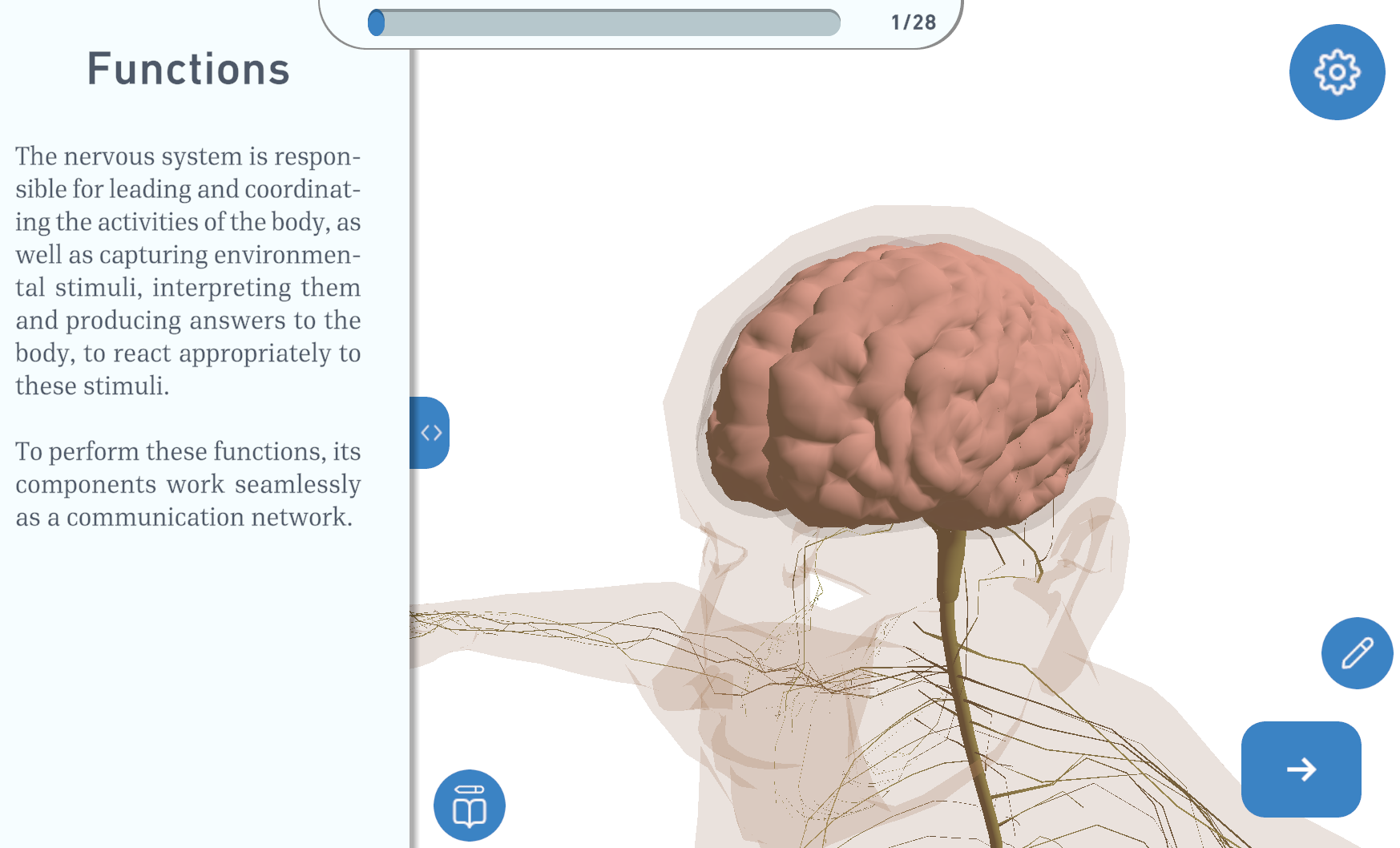
Open the 3D model of the nervous system in the app and try to notice:
- What parts make up this system?
- How is it distributed throughout the body?
- What seems most “central,” and what is more widely distributed?
Reflect:
- Do you think all of the body's responses are conscious?
- What allows the body to react so quickly?
Write down your hypotheses in your notebook before moving on.
💡 Teacher's tip:
Value the hypotheses raised by students, even if incomplete. They will be revisited throughout the next steps.
Step 2 — Investigating
How Does the Nervous System Work?
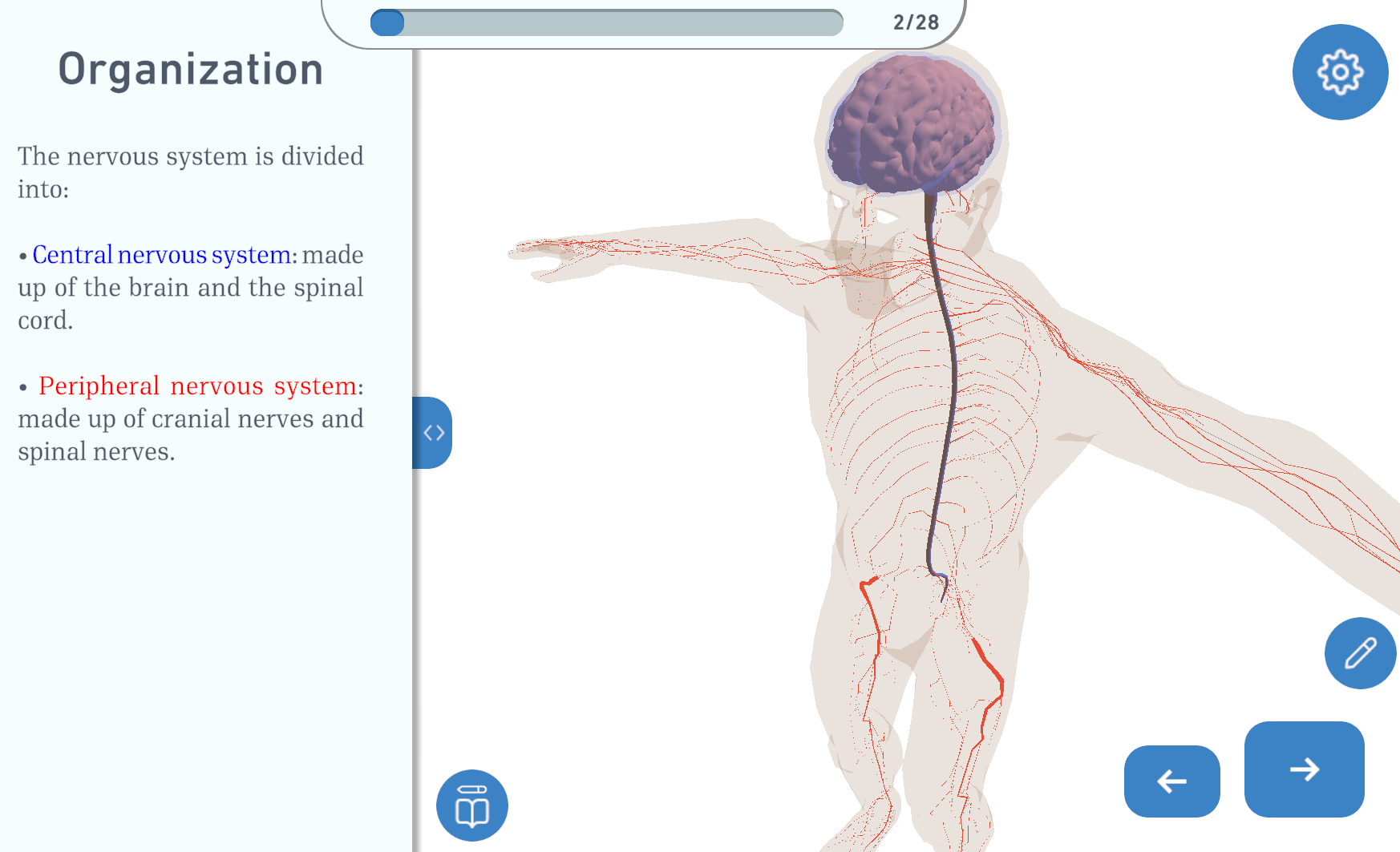
The nervous system works like a communication network for the body and is divided into two major systems:
Central Nervous System (CNS)
- Brain (cerebrum, cerebellum, brainstem)
- Spinal cord
Peripheral Nervous System (PNS)
- Nerves spread throughout the body
The CNS is responsible for processing information and coordinating the body's responses. The PNS transmits signals between the body and the CNS.
With this in mind, answer:
- If the PNS were damaged, what might happen to communication between the body and the CNS?
- Why does it make sense to call the brain and spinal cord "central"?
💡 Teacher's tip:
Return to the hypotheses from Step 1 and encourage students to compare their initial answers with the concepts they have now built.
Step 3 — Building Ideas
Neurons and the Body's Communication
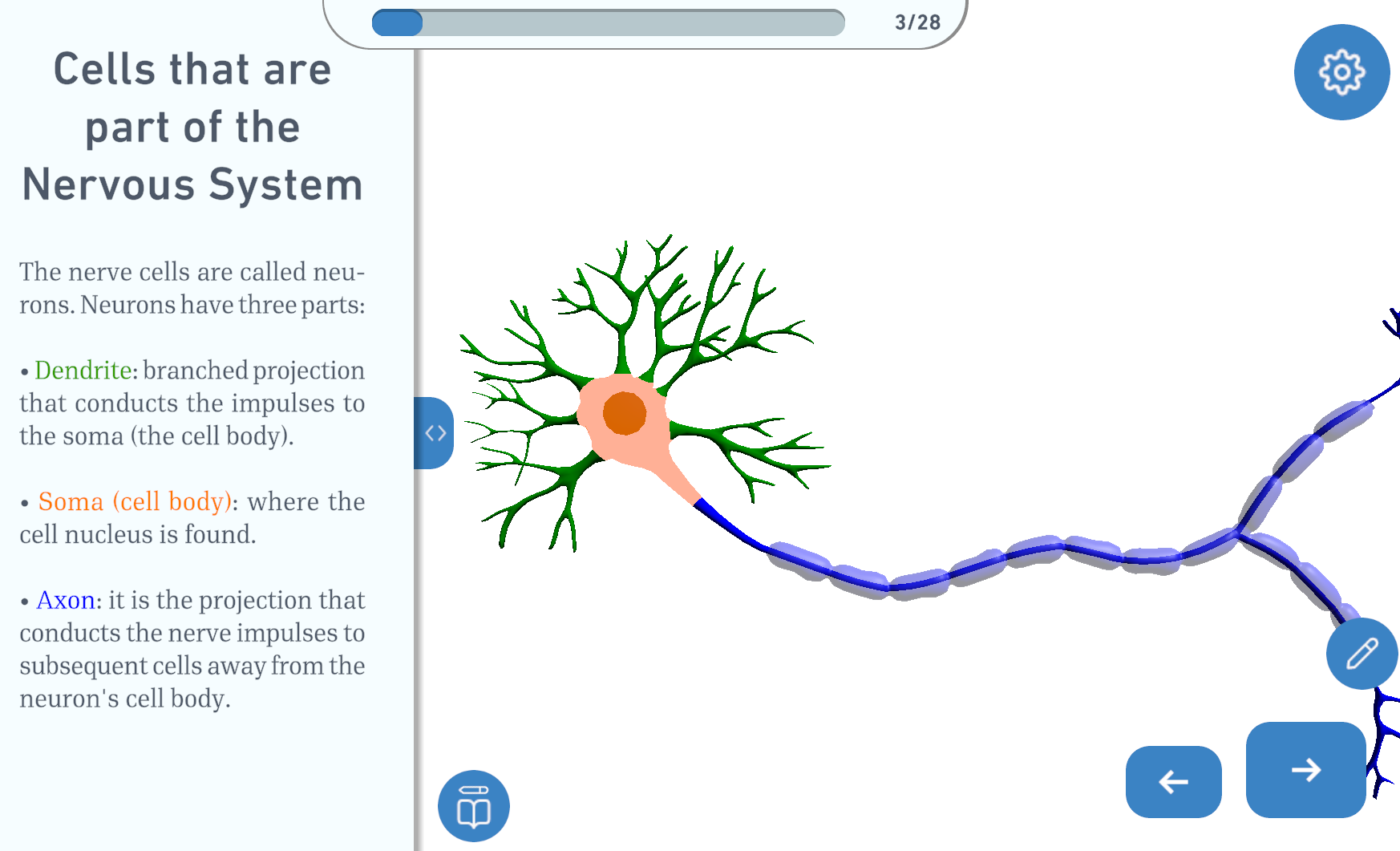
Neurons are the cells responsible for transmitting information throughout the body. They have three main parts:
- Dendrites — receive information.
- Cell body — processes the information.
- Axon — transmits information to other cells.
Communication between neurons happens through nerve impulses. The point of contact between one neuron and another is called a synapse; it is at this region that information is passed from one cell to the next.
Think about it:
- What would happen if this communication failed?
- How would that impact the body?
💡 Teacher's tip:
Have students connect the concept of synapse to concrete situations, such as reflexes or emotional reactions.
Step 4 — Connecting the Dots
The Nervous System in Action
Just as neurons transmit information through synapses, you will simulate this process as a group.
How it works:
Divide the class into groups of five students. Two members of each group will stand at the start to answer the questions the teacher will ask. When they know the answer, they will pass it on to the other three classmates — like a telephone game, simulating the synapse between neurons. The group that answers correctly first earns a point.
Your notes from the previous steps will come in very handy here.
Game Questions
1. What are the three main parts of a neuron?
- a. Brain, dendrite, and cell body.
- b. Cell body, dendrite, and axon.
- c. Spinal cord, dendrite, and axon.
- d. Cell body, brain, and spinal cord.
2. This is an extension that leaves the cell body and conducts nerve impulses:
- a. Axon.
- b. Brain.
- c. Spinal cord.
- d. Cerebellum.
3. What is a synapse?
- a. The region of contact between a neuron and the body's organs.
- b. The region of contact between a neuron and blood vessels.
- c. The region of contact between neighboring neurons, through which stimuli pass.
- d. The region of contact between the axon and the cell body.
4. The following are parts of the brain:
- a. Mesencephalon and neuron.
- b. Mesencephalon and medulla oblongata.
- c. Medulla oblongata and nerves.
- d. Axon and pons.
5. The cerebrum is composed of two regions:
- a. Telencephalon and thalamus.
- b. Thalamus and hypothalamus.
- c. Telencephalon and diencephalon.
- d. Corpus callosum and neuron.
6. The meninges are divided into three layers:
- a. Pia mater, arachnoid, and dura mater.
- b. Pia mater, dura mater, and axon.
- c. Pia mater, dura mater, and cell body.
- d. Arachnoid, pia mater, and axon.
7. Which structure is responsible for controlling vital functions such as respiratory movements and blood pressure?
- a. Pons.
- b. Cerebellum.
- c. Thalamus.
- d. Medulla oblongata.
Answers: 1-B · 2-A · 3-C · 4-B · 5-C · 6-A · 7-D
Step 5 — Leveling Up
The Nervous System and Health
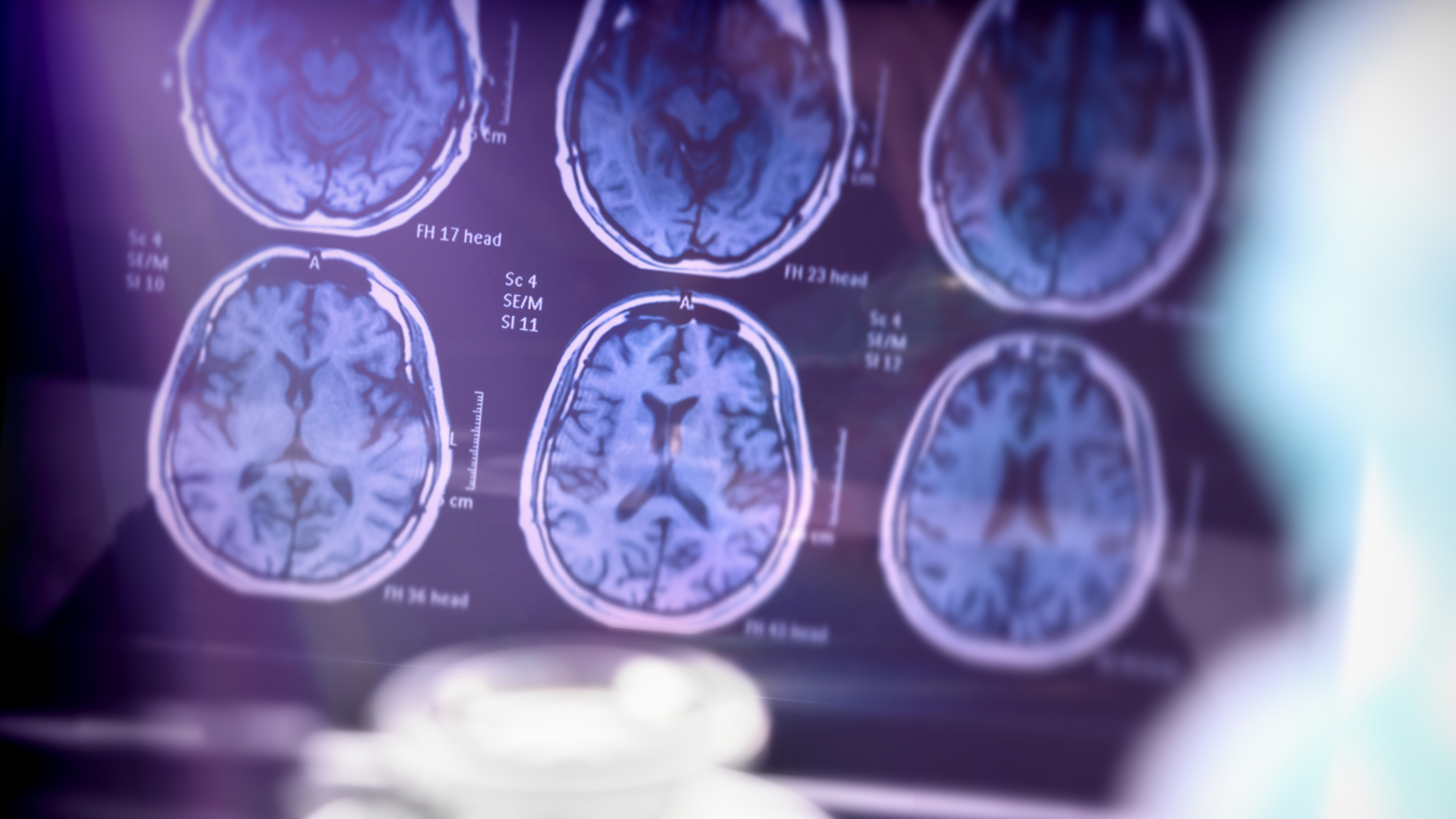
The nervous system can be affected by many conditions. Research one of the following:
- Alzheimer's disease
- Parkinson's disease
- Stroke (CVA)
For your research, answer:
- Which part of the nervous system is affected? How does the part affected by the condition you chose work?
- What causes the condition? How does it impact the lives of those affected?
- Is there treatment or prevention? What can we do to support our neurological health?
Once you have completed your research, present your findings to the class.
💡 Teacher's tip:
Value the connections students make between the conceptual content and the real-life impact of neurological conditions. Encourage the use of reliable sources in their research.
Throughout this Guided Learning experience, you:
- Understood how the nervous system coordinates everything that happens in your body.
- Discovered how neurons communicate through nerve impulses and synapses.
- Connected the body's functioning to real situations from your everyday life.
- Investigated how the health of the nervous system impacts your life.
Now that you have a better understanding of how the nervous system works, can you see just how present it is in every moment of your life?
👉 Want to keep learning?
Access the quizzes in the app and deepen your knowledge about the nervous system on Inspire Universe.
This material is protected by copyright. Reproduction, distribution, or sharing, in whole or in part, without authorization from Inspire Universe, is prohibited under Brazilian Copyright Law (Law No. 9,610/1998).

Copyright © 2025 | Universo Inspira