
Guided Learning
The Earth in Motion
Area: Social Studies
Theme: Tectonic Plates
Grade: 6th grade
Estimated time: ⏱️ 2 classes
🔍 Investigation · 🧠 Critical Thinking
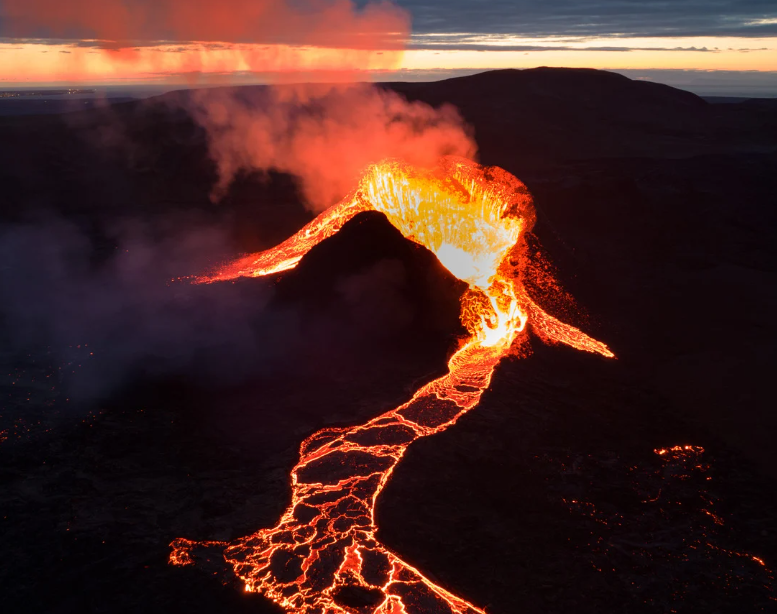
Letter to the User
Guided Learning – Inspire Universe
Welcome to Inspire Universe's Guided Learning.
The Guided Learning tracks were created to help you organize your studies, deepen your understanding of the content, and turn scientific concepts into hands-on learning experiences.
Each track brings together structured activities, experiments, challenges, reflections, and investigative tasks that can be used in two ways:
- By the teacher, as a support tool for planning and delivering classroom activities.
- By the student, as a step-by-step study guide for learning inside and outside of school.
Here, learning goes beyond watching or reading: you are invited to observe, test, measure, compare, calculate, reflect, and connect ideas — developing essential scientific skills such as critical thinking, curiosity, and intellectual independence.
The activities were organized into thematic tracks, written in clear, accessible language, and designed to accompany you at every stage of your learning path, from your first contact with the topic to mastering the content.
At the end of each track, we invite you to keep exploring:
- Completing the quizzes available in the app,
- Revisiting the digital content,
- Deepening your understanding of the Universe and the scientific phenomena that surround us.
About the Use of This Material
This material is made available exclusively for educational use within the Inspire Universe platform.
Reproduction, distribution, commercialization, or sharing of this content, in whole or in part, by any means, without express authorization, is prohibited.
The responsible use of this material ensures that the educational, editorial, and scientific work involved in its creation is properly valued and allows us to continue developing new tracks, content, and learning experiences for you.
Evobooks Team
What will you learn?
You will learn what tectonic plates are and how they move, differentiate the main types of plate boundaries, connect plate movement to phenomena such as earthquakes and tsunamis, and understand why some regions of the planet are more geologically unstable than others.
Why does this matter?
Earth's surface is made up of large blocks that move slowly, and these movements shape mountains, oceans, volcanoes, and even entire cities. Understanding tectonic plates helps you understand why earthquakes occur, how mountain ranges form, and how scientific knowledge contributes to natural disaster prevention.
Step 1 — Exploring
Connecting to the Real World
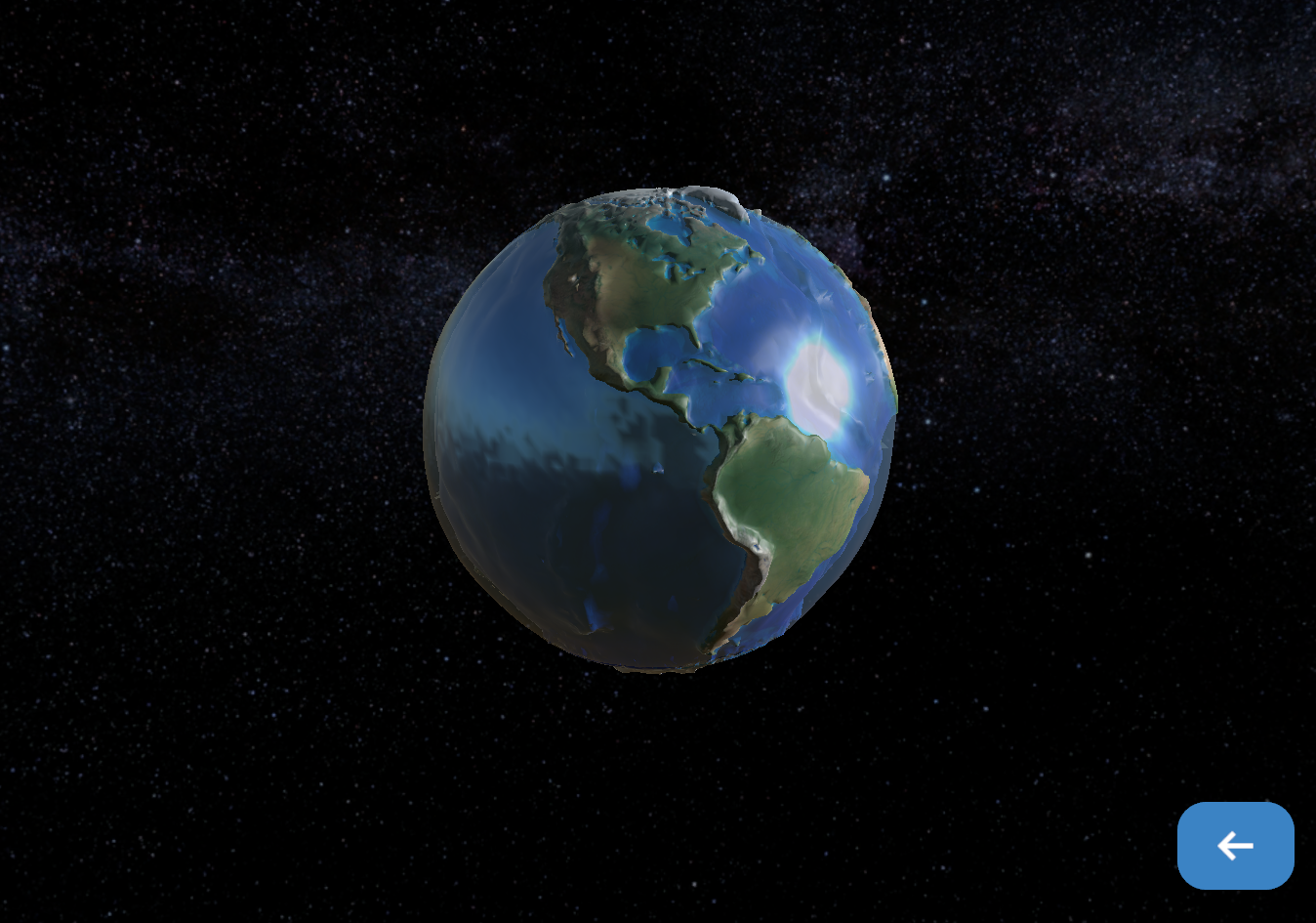
Open the Inspire Universe app and look at the Earth’s representation, noticing the layer that surrounds the entire planet. Use the zoom option to see how Earth relates to its outside structures.
Think about it:
- If we cannot see the atmosphere, how do we know it exists?
- How thin does the atmosphere look compared to Earth? What does that tell you about how fragile it might be?
- What do you think would happen if Earth did not have this gaseous layer?
💡 Teacher's tip:
Encourage students to connect the atmosphere to everyday experiences, such as breathing, feeling the wind, or looking up at the sky.
Step 2 — Investigating
Is the Earth Really Still?
If the Earth were completely rigid, there would be no earthquakes, volcanoes, or new mountain formation. So what is happening inside the planet?
Look at the digital model again. Notice that the Earth's surface is not a single continuous layer; it is made up of large blocks called tectonic plates.
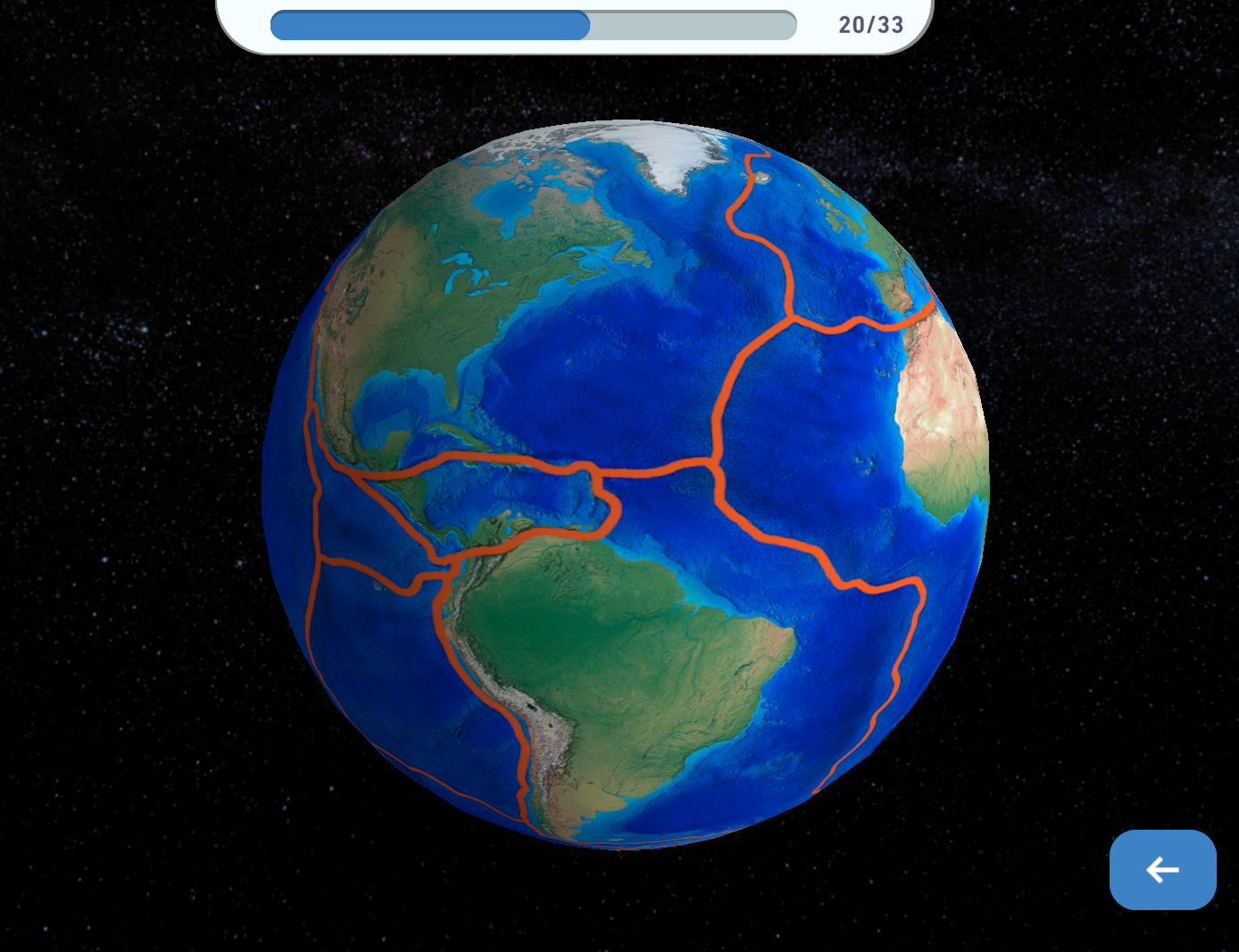
With that in mind, investigate:
- What are tectonic plates
- Where are they located?
- What drives their movement?
- Is the movement of these plates fast or slow?
- If it is slow, why can its effects be so intense?
Write down your hypotheses in your notebook before moving on.
Did you know?
The interior of the Earth is extremely hot. This heat generates mantle convection, slowly driving the plates at the surface. That is why, even though the movement is imperceptible on a day-to-day basis, its cumulative effects over time are enormous.
Step 3 — Building Ideas
When Plates Meet
Tectonic plates do not move independently; they interact with one another. There are three main types of plate boundaries:
- Divergent boundary: the plates move apart. This occurs mainly on the ocean floor, where mantle material rises and forms oceanic ridges.
- Convergent boundary: the plates collide. One may sink beneath the other, forming ocean trenches and mountain ranges, or generating intense volcanic activity.
- Transform boundary: the plates slide laterally past each other, producing frequent earthquakes.
Observe the interactive map and identify regions near plate boundaries.
Think about this:
- What happens when two plates collide?
- Why are earthquakes more frequent in certain regions of the world?
- What can happen when plates move apart on the ocean floor?
💡 Teacher's tip:
Guide the analysis through orienting questions, enabling the students to establish connections between plate movement and its geographic consequences.
Step 4 — Tackling Challenges
The atmosphere and natural phenomena
Now that you are familiar with the types of plate boundaries, apply that knowledge using the app's interactive map:
- Identify the main tectonic plates.
- Observe which ones are near Brazilian territory.
- Compare more stable regions with regions of intense seismic activity.
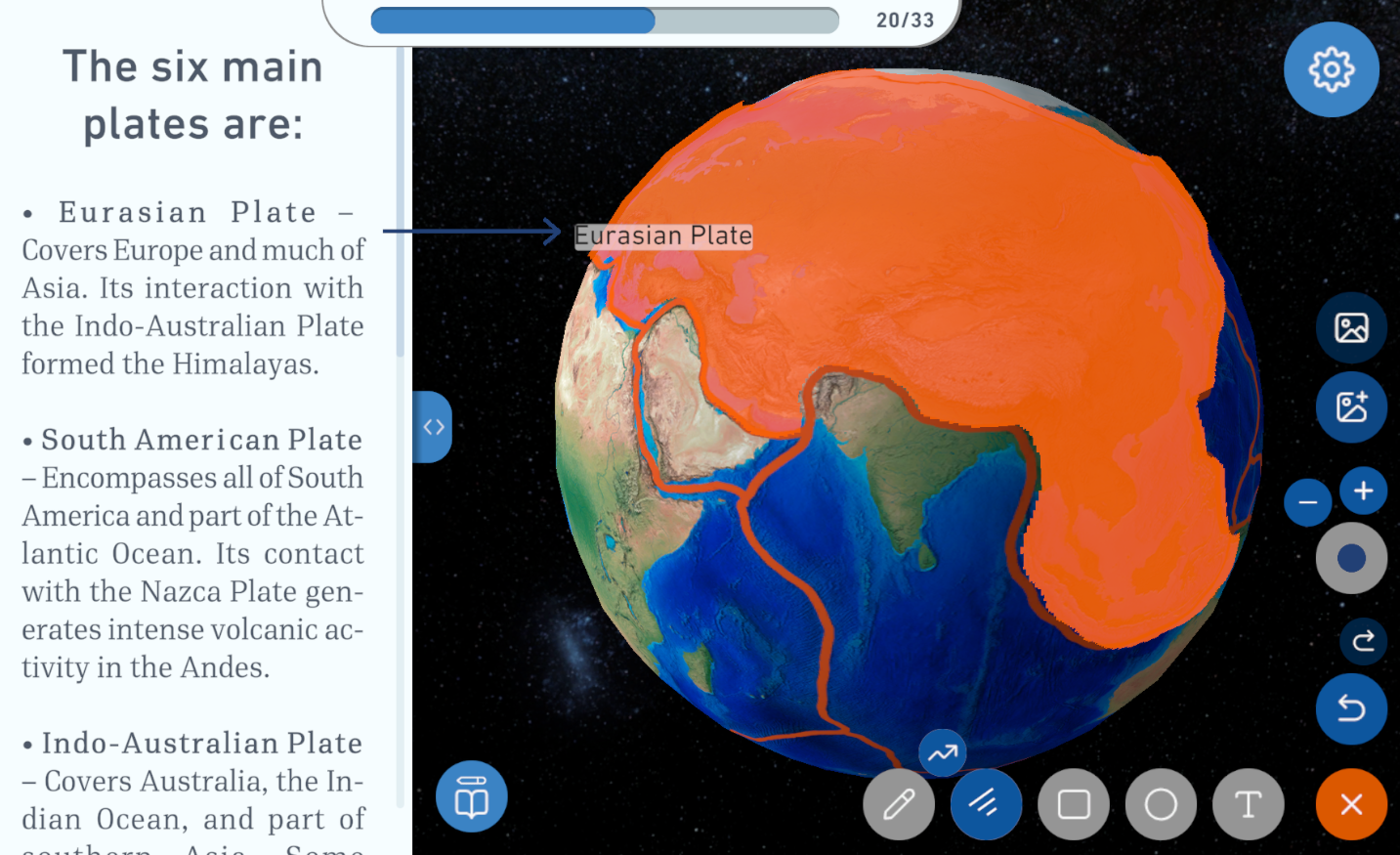
Reflect:
- Which plate is Brazil located on?
- Is Brazil near an active boundary?
- Does this help explain why the country does not experience major earthquakes?
💡 Teacher's tip:
Value students' reasoning before presenting the answers. The questions are progressive.
Step 5 — Connecting the Dots
When Movement Makes the News
What you have learned about tectonic plates plays out in real events that affect millions of people. Research a real-world case of an earthquake or tsunami and analyze:
- Where did it occur?
- Which type of plate boundary was involved?
- What were the main impacts on the population?
- How did the community reorganize after the event?
Reflect:
- Why is the study of tectonic plates essential for urban planning and natural risk prevention?
💡 Teacher's tip:
Encourage students to choose events from different regions of the world to broaden the comparison. Value the connections between scientific content and human impact.
Throughout this Guided Learning experience, you:
- Investigated the internal dynamics of the Earth.
- Understood that the planet is in constant motion.
- Connected natural phenomena to plate boundaries.
- Linked scientific knowledge to the organization of society.
Now that you understand how tectonic plates work, can you see how they shape the planet we live on?
👉 Want to keep learning?
Access the quizzes in the app and deepen your understanding of our planet's dynamics in Inspire Universe.
This material is protected by copyright. Reproduction, distribution, or sharing, in whole or in part, without authorization from Inspire Universe, is prohibited under Brazilian Copyright Law (Law No. 9,610/1998).

Copyright © 2025 | Universo Inspira