
Guided Learning
The Atmosphere: Earth's Gaseous Layer
Area: Social Studies
Theme: Energy, atmosphere, and
ecosystems
Grade: 6th grade
Estimated time: ⏱️ 2 classes
👁️ Observation · 🔍 Investigation
Letter to the User
Guided Learning – Inspire Universe
Welcome to Inspire Universe's Guided Learning.
The Guided Learning tracks were created to help you organize your studies, deepen your understanding of the content, and turn scientific concepts into hands-on learning experiences.
Each track brings together structured activities, experiments, challenges, reflections, and investigative tasks that can be used in two ways:
- By the teacher, as a support tool for planning and delivering classroom activities.
- By the student, as a step-by-step study guide for learning inside and outside of school.
Here, learning goes beyond watching or reading: you are invited to observe, test, measure, compare, calculate, reflect, and connect ideas — developing essential scientific skills such as critical thinking, curiosity, and intellectual independence.
The activities were organized into thematic tracks, written in clear, accessible language, and designed to accompany you at every stage of your learning path, from your first contact with the topic to mastering the content.
At the end of each track, we invite you to keep exploring:
- Completing the quizzes available in the app.
- Revisiting the digital content.
- Deepening your understanding of the Universe and the scientific phenomena that surround us.
About the Use of This Material
This material is made available exclusively for educational use within the Inspire Universe platform.
Reproduction, distribution, commercialization, or sharing of this content, in whole or in part, by any means, without express authorization, is prohibited.
The responsible use of this material ensures that the educational, editorial, and scientific work involved in its creation is properly valued and allows us to continue developing new tracks, content, and learning experiences for you.
Evobooks Team
What will you learn?
You will learn about the atmosphere, how it forms, how it is arranged into layers, and why Earth's gaseous layer is necessary for life on the planet.
Why does this matter?
Even though it is invisible, the atmosphere protects the planet, allows living beings to breathe, regulates temperature, and influences natural phenomena such as climate, clouds, and rain. Understanding its structure allows us to comprehend how the planet functions as a whole.
Etapa 1 — Step 1 — Exploring
A First Look at Earth's Atmosphere
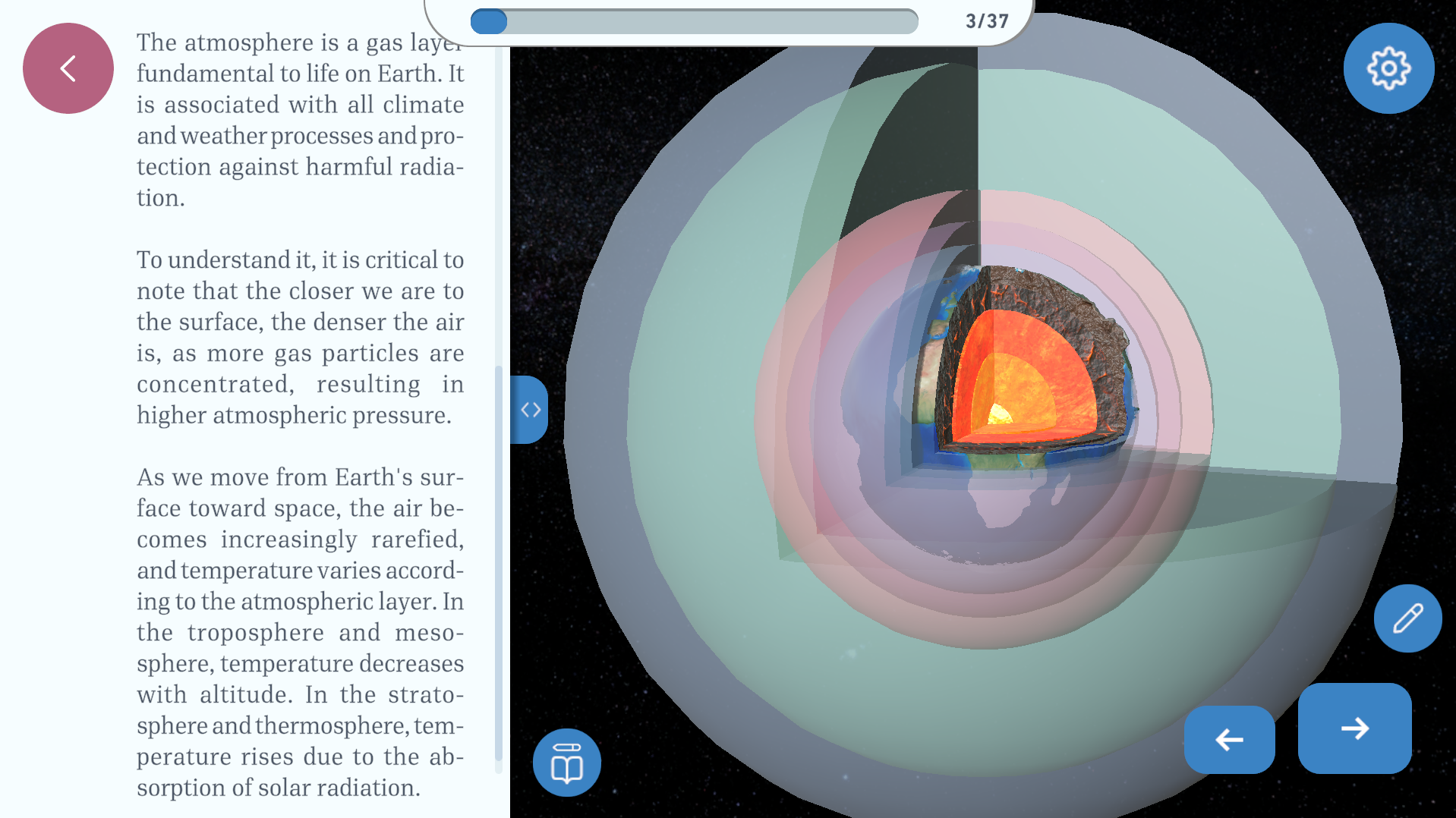
Open the Inspire Universe app and look at the Earth’s representation, noticing the layer that surrounds the entire planet. Use the zoom option to see how Earth relates to its outside structures.
Think about it:
- If we cannot see the atmosphere, how do we know it exists?
- How thin does the atmosphere look compared to Earth? What does that tell you about how fragile it might be?
- What do you think would happen if Earth did not have this gaseous layer?
💡 Teacher's tip:
Encourage students to connect the atmosphere to everyday experiences, such as breathing, feeling the wind, or looking up at the sky.
Step 2 — Investigating
What makes up Earth's gaseous layer?
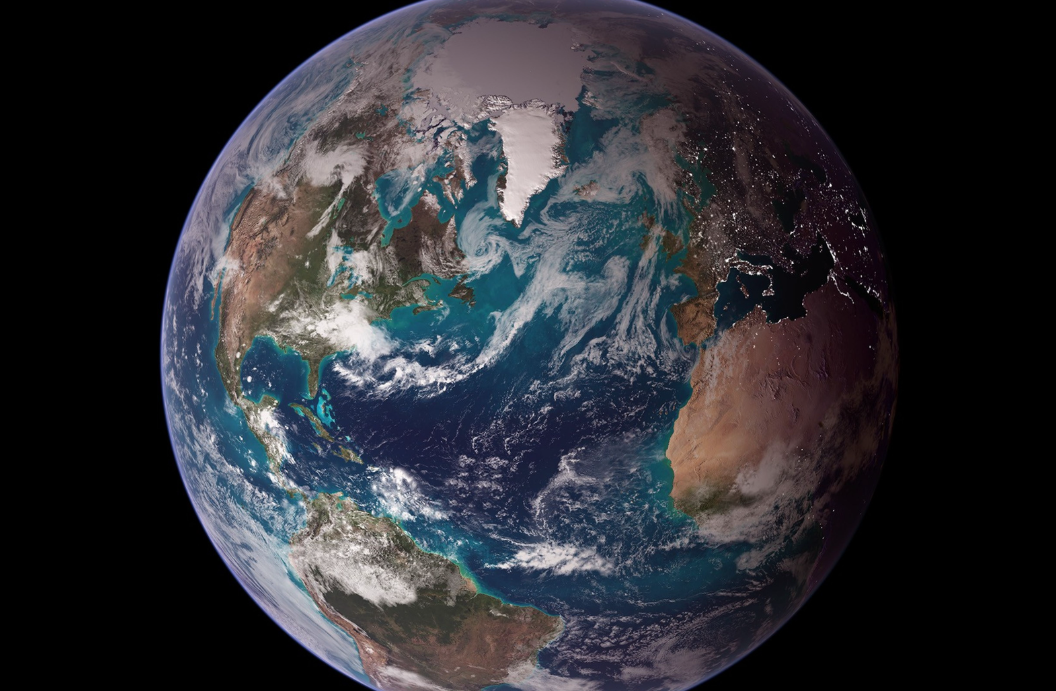
Source: NASA.
Description: Image of Earth as seen from space, showing the blue outline of the atmosphere.
Credit: NASA / ISS (International Space Station)
Now, in groups or individually, research:
- What gases make up the atmosphere?
- Which gas is the most abundant?
Research tip: Use keywords such as "composition of Earth's atmosphere."
(After research) The atmosphere is made up primarily of nitrogen and oxygen, along with small amounts of argon, carbon dioxide, and other gases. Nitrogen is the most abundant, accounting for approximately 78% of its total composition.
💡 Teacher's tip:
Use this moment to discuss reliable sources of scientific information and to work with percentages in a simple, accessible way.
Step 3 — Building Ideas
The layers of the atmosphere
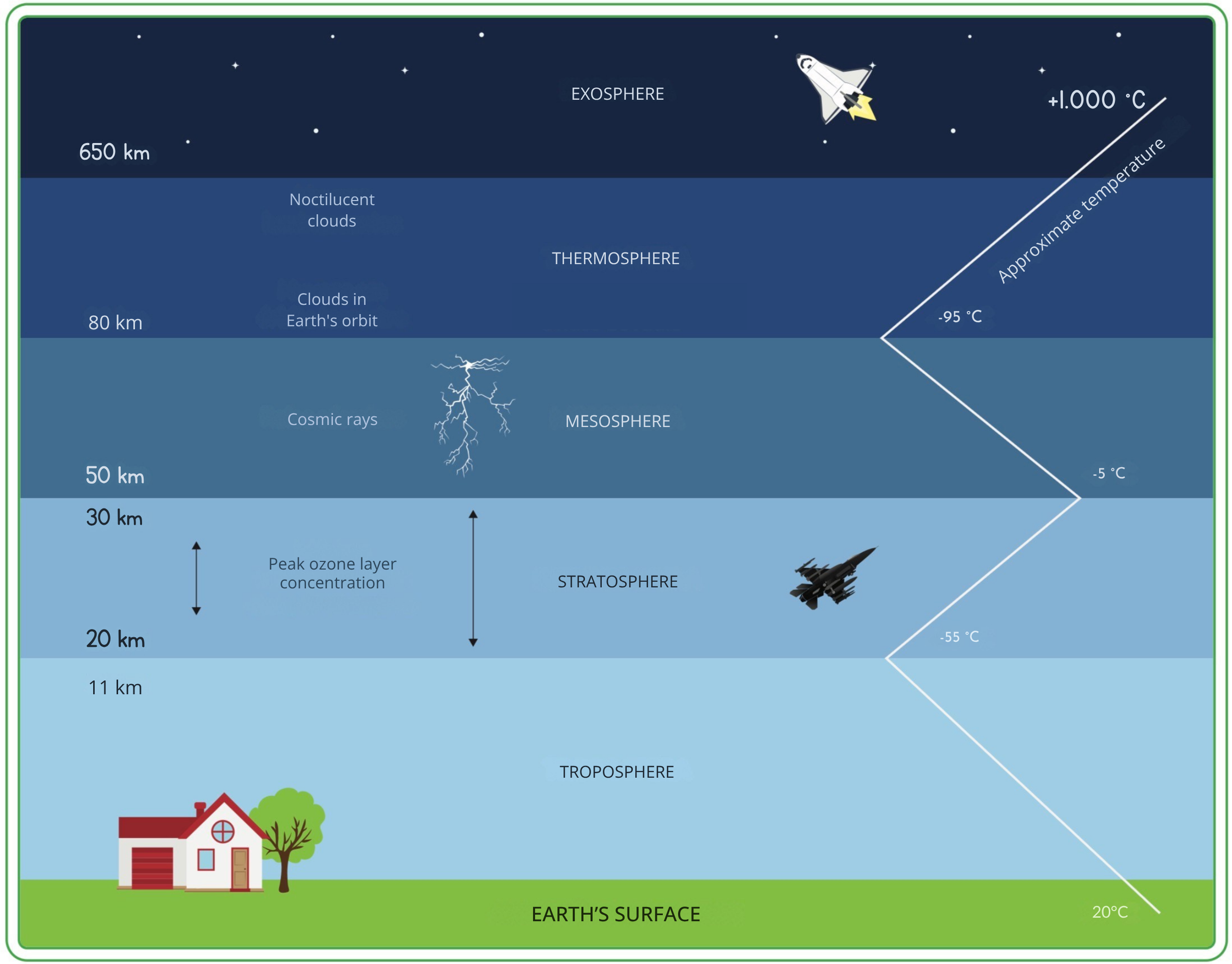
The atmosphere is not made up of a single layer. It is organized into distinct regions.
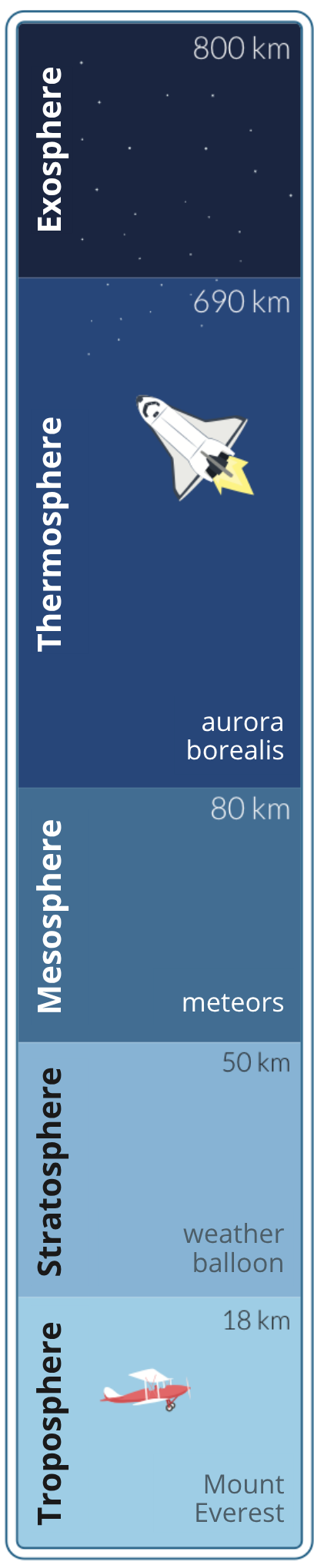
Open the app and identify:
- Troposphere
- Stratosphere
- Mesosphere
- Thermosphere
- Exosphere
The atmosphere is the gaseous layer that covers planets. The Earth's atmosphere is made up of numerous gases held in place by gravity and the planet's magnetic field.
The troposphere is the layer that stretches from the Earth’s surface to the stratosphere's base. It makes up around 80% of the total atmospheric mass and is the only layer in which living things can breathe properly. Its average thickness is approximately 12 kilometers (7.5 miles). Almost all weather occurrences happen within this stratum.
The stratosphere begins at roughly 7 to 17 kilometers (4.5–10.5 miles) above the surface and extends to about 50 kilometers. It is characterized by horizontal air motion, low water vapor concentrations, and a gradual rise in temperature with altitude, reaching its upper boundary at the stratopause.
The mesosphere extends from approximately 50 to 80–85 kilometers (31–50/53 miles) above the surface and is the layer where the most significant temperature drop occurs, reaching as low as −90 °C (-130 °F) at its upper boundary. It is also where meteoroids burn up upon entry into the atmosphere.
Think about it:
- Which of these layers do we live in?
- Where do clouds form?
- How high can airplanes reach?
💡 Teacher's tip:
Help students understand that the layers are not rigid divisions, but regions with distinct characteristics.
Step 4 — Making connections
The atmosphere and natural phenomena
Based on what you have learned, answer:
- Why do most weather phenomena occur in the troposphere?
- How does the atmosphere help protect Earth?
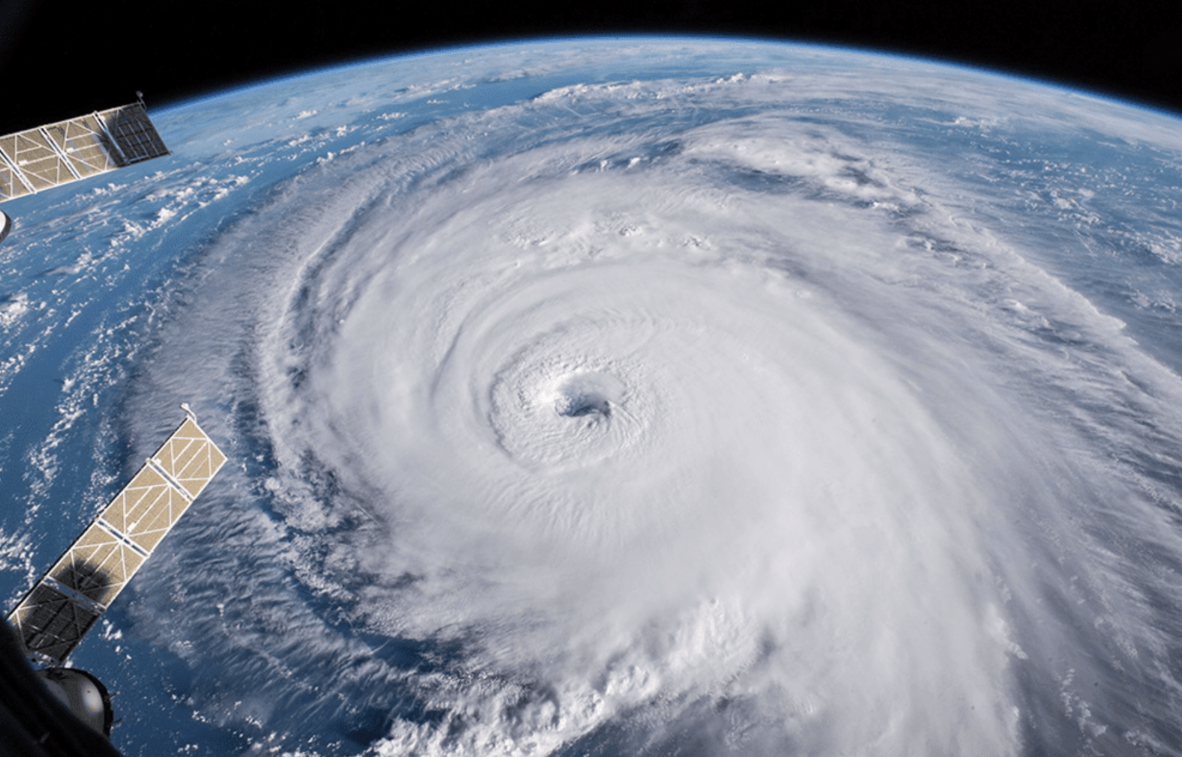
Source: NASA / NOAA
Type: Meteorological satellite image
Credit: NASA Earth Observatory
💡 Teacher's tip:
If needed, lead the discussion as a whole-class activity, connecting temperature, altitude, and gas concentration.
Step 5 — Putting It All Together
A Thin Layer, a Big Role
Now, reflect:
- In what ways could human activity weaken the atmosphere's role as Earth's shield?
- What might happen to the planet if this gaseous layer were reduced?
In the previous step, you learned that the atmosphere protects Earth like a shield. But this shield can be weakened.
Human activity can affect the atmosphere:
- Burning fuel releases gases that build up in the atmosphere.
- Deforestation reduces the planet's natural balance.
- Certain chemicals can thin the ozone layer, letting in more radiation.
A weakened atmosphere would mean:
- Extreme heat during the day, extreme cold at night.
- No rain, no wind, no clouds.
- More harmful sunlight reaching the surface.
- Less air to breathe.
Now choose a way to show what you have learned — a drawing, a diagram, a collage, or a short explanation in your own words. What does Earth look like with its shield? What would it look like without it?
💡 Teacher's tip:
Value different forms of expression and encourage explanations grounded in what was observed and investigated.
Step 6 — Fun Fact
Satellites in Orbit Observing Earth from Space
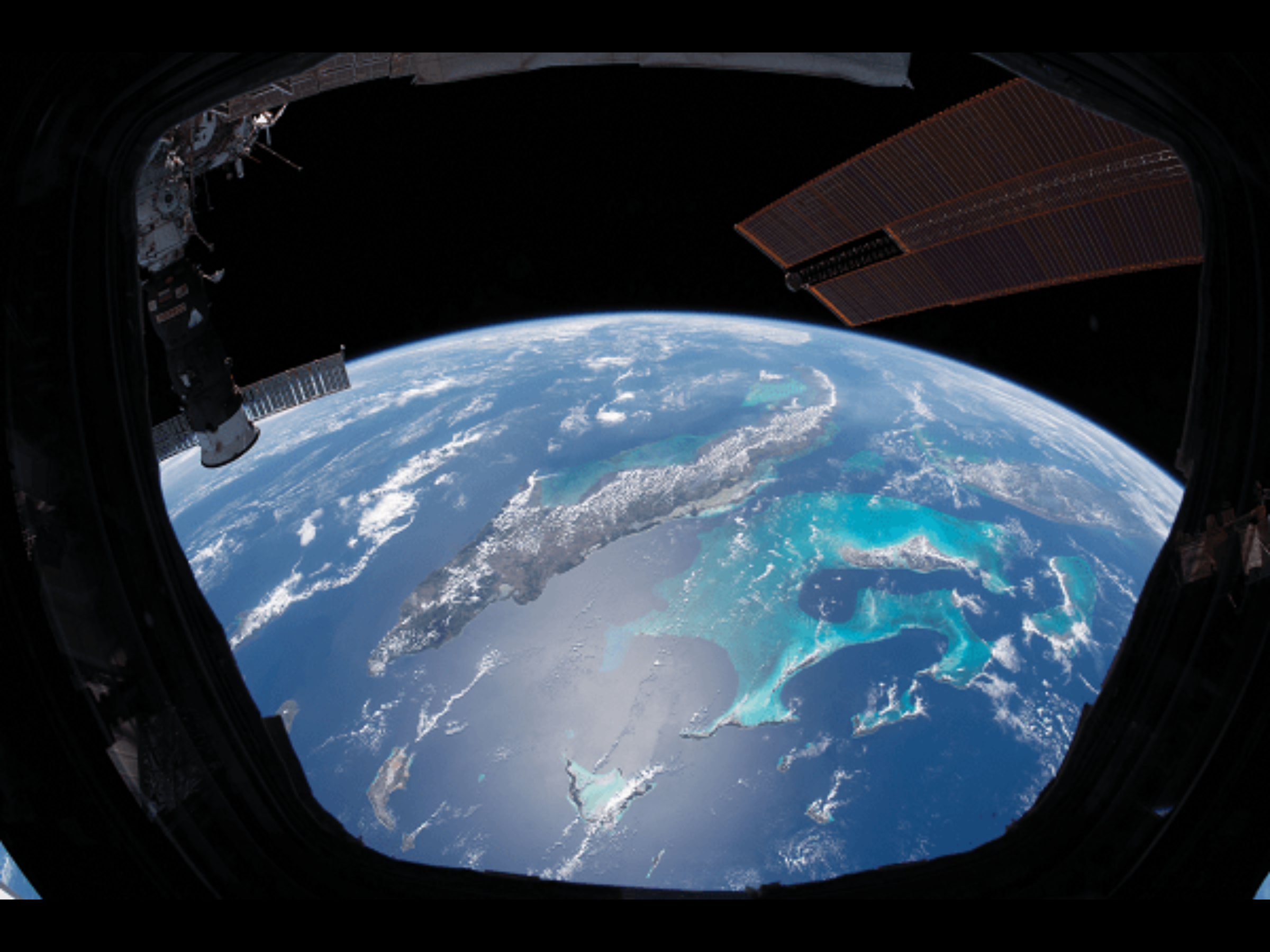
The International Space Station orbiting Earth, with the planet's curvature visible in the background.
Fonte: NASA
Crédito: NASA / International Space Station (ISS)
Artificial satellites do not "hover in the sky." They orbit Earth at different altitudes, each serving a different purpose:
- Low Earth Orbit (LEO): approximately 160 to 2,000 km (100–1,240 miles). Observation satellites and the International Space Station operate here.
- Higher orbits: communications, GPS, and TV satellites.
Seeing the Weather from Above
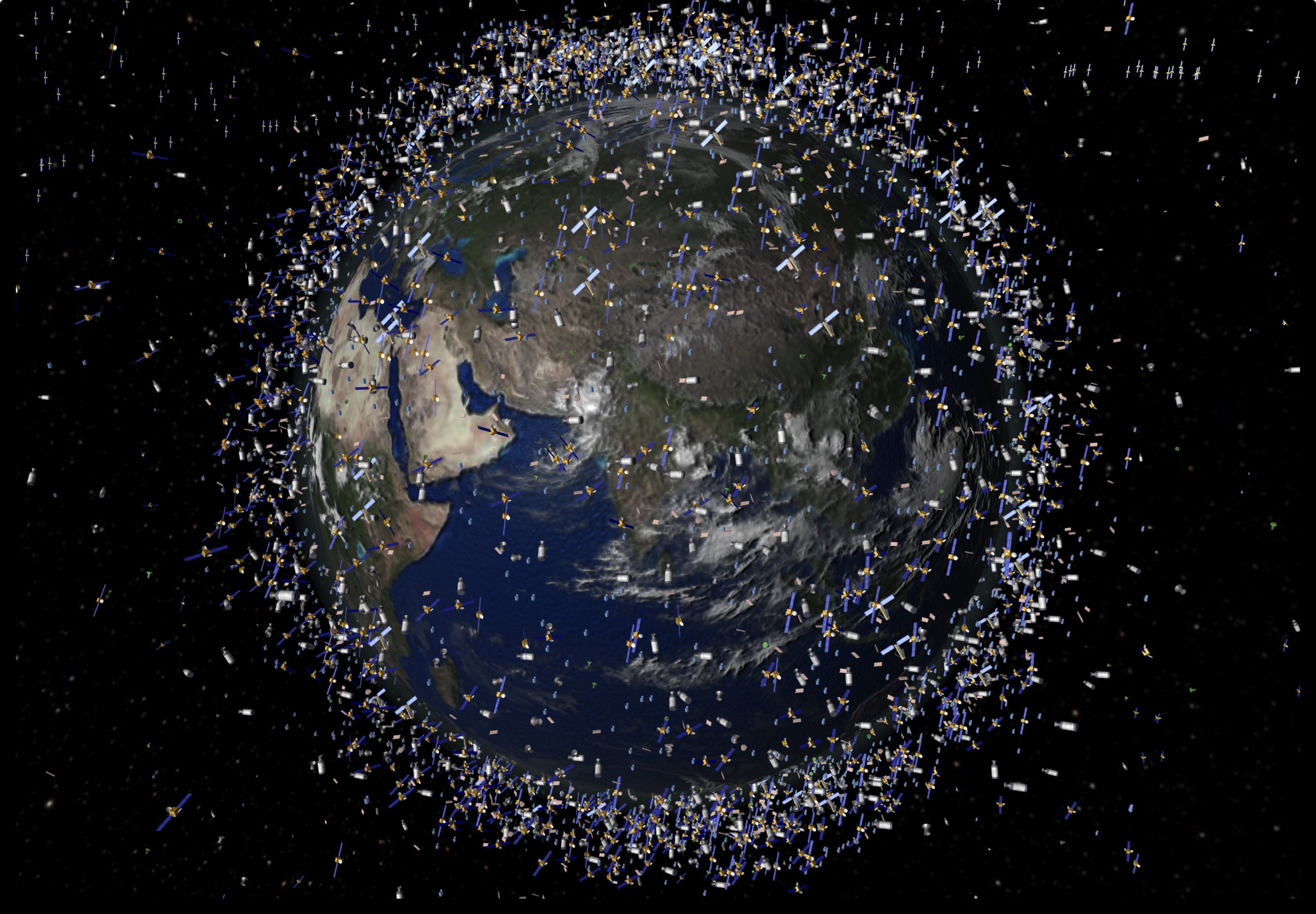
Image courtesy of the European Space Agency.
Note: The debris field shown in the image is an artistic representation based on real data. However, the debris objects are depicted at an exaggerated scale to make them visible at the resolution shown.
Many of the images we see in weather forecasts come from meteorological satellites. From up there, they observe clouds, hurricanes, storms, cold fronts, and climate patterns, enabling weather forecasting, monitoring extreme events, and studying the atmosphere on a global scale.
Did you know?
Rockets travel through Earth’s layers to reach space, where astronauts live and work aboard the International Space Station. Even from up there, many studies remain focused on understanding and protecting Earth.
Throughout this Guided Learning experience, you:
- Explored Earth's gaseous layer,
- Investigated the composition of the atmosphere.
- Identified its layers.
- Connected the atmosphere to life on the planet.
- Learned about satellites and space exploration.
Now that you have a deeper understanding of how the atmosphere works, can you see how essential it is to life on Earth?
👉 Want to keep learning?
Access the quizzes in the app and deepen your knowledge about Earth and its structures on Inspire Universe.
This material is protected by copyright. Reproduction, distribution, or sharing, in whole or in part, without authorization from Inspire Universe, is prohibited under Brazilian Copyright Law (Law No. 9,610/1998).

Copyright © 2025 | Universo Inspira