
Guided Learning
How Large Is the Sun?
Area: Science
Theme: The Solar System – the Universe
Grade: 6th grade
Estimated time: ⏱️ 2 classes
🔬 Experiment · 🧮 Calculation
Letter to the User
Guided Learning – Inspire Universe
Welcome to Inspire Universe's Guided Learning.
The Guided Learning tracks were created to help you organize your studies, deepen your understanding of the content, and turn scientific concepts into hands-on learning experiences.
Each track brings together structured activities, experiments, challenges, reflections, and investigative tasks that can be used in two ways:
- By the teacher, as a support tool for planning and delivering classroom activities;
- By the student, as a step-by-step study guide for learning inside and outside of school.
Here, learning goes beyond watching or reading: you are invited to observe, test, measure, compare, calculate, reflect, and connect ideas — developing essential scientific skills such as critical thinking, curiosity, and intellectual independence.
The activities were organized into thematic tracks, written in clear, accessible language, and designed to accompany you at every stage of your learning path, from your first contact with the topic to mastering the content.
At the end of each track, we invite you to keep exploring:
- Completing the quizzes available in the app.
- Revisiting the digital content,
- Deepening your understanding of the Universe and the scientific phenomena that surround us.
About the Use of This Material
This material is made available exclusively for educational use within the Inspire Universe platform.
Reproduction, distribution, commercialization, or sharing of this content, in whole or in part, by any means, without express authorization, is prohibited.
The responsible use of this material ensures that the educational, editorial, and scientific work involved in its creation is properly valued and allows us to continue developing new tracks, content, and learning experiences for you.
Evobooks Team
What will you learn?
You will discover just how large the Sun is and how scientists estimate the size of celestial bodies that are very far from Earth.
Why does it matter?
The distances and dimensions of the Solar System are far greater than anything we encounter in everyday life. Understanding these measurements helps us better grasp Earth's place in the Universe and how science uses models and experiments to study natural phenomena.
Step 1 — Exploring
The Sun in the Solar System
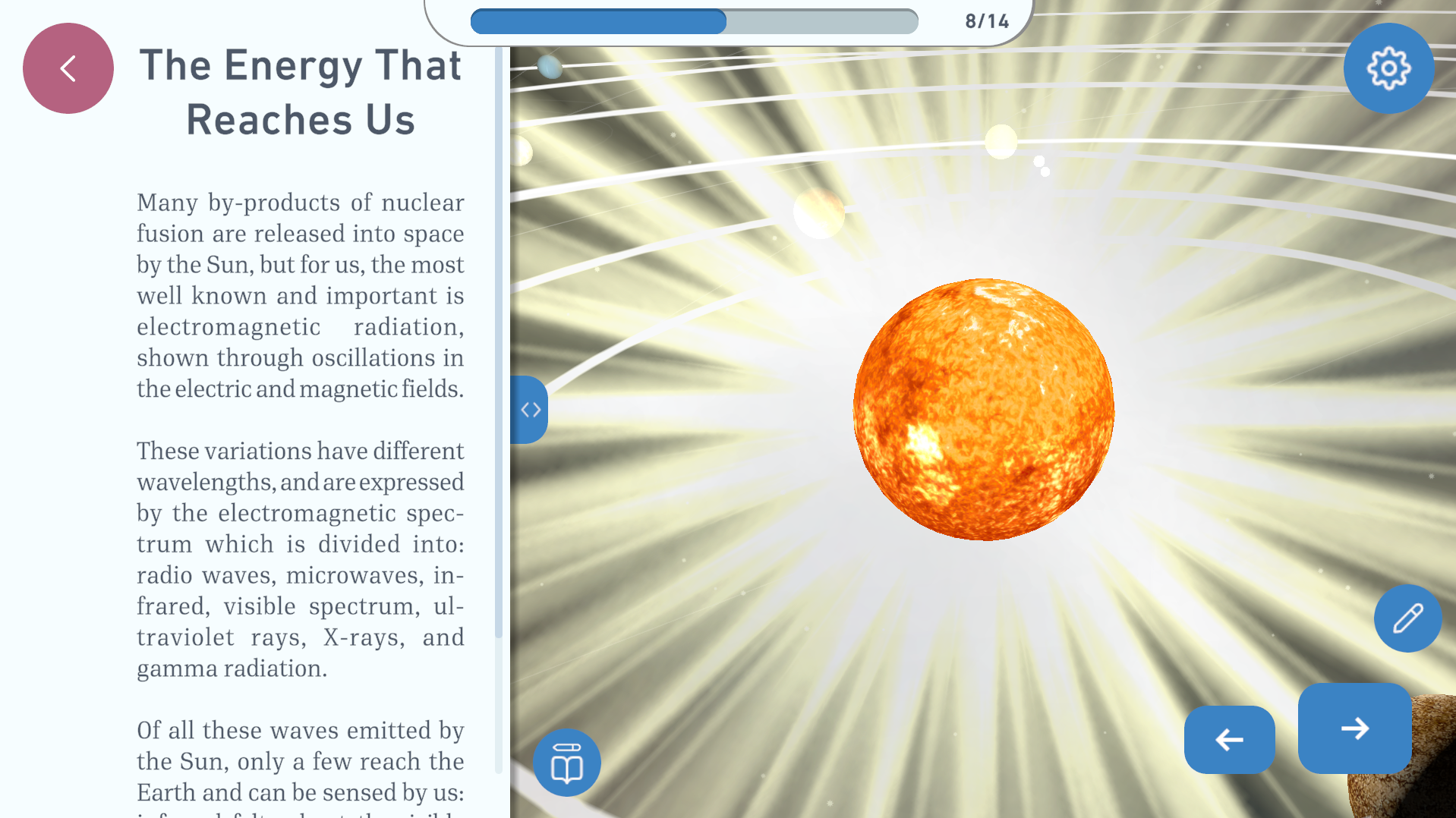
Open the Inspire Universe app and observe the Solar System. Use the zoom feature to notice Earth's position and its distance from the Sun.
Think about it:
- Did you know that the Sun is a star?
- Can you imagine how large it is?
💡 Teacher's tip:
Let students explore the visualization freely and describe what they observe before any theoretical explanation is introduced.
Step 2 — Investigating
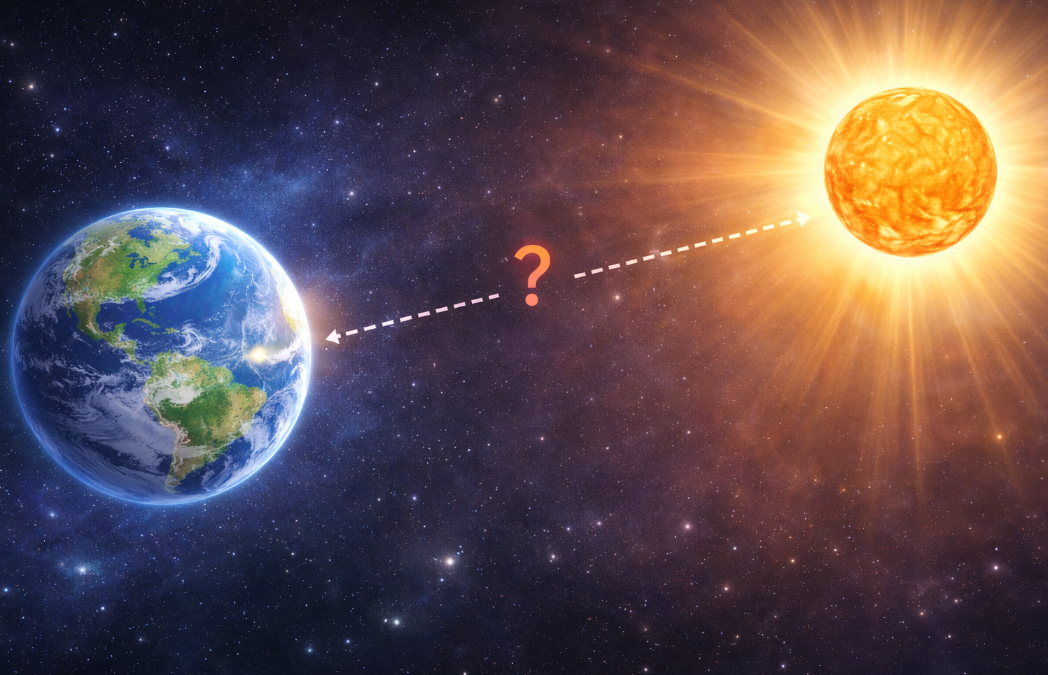
The Distance Between Earth and the Sun
Now, in groups or individually, research the average distance between Earth and the Sun.
Research tip: Use keywords such as "Earth–Sun distance." (Values may vary depending on the source.)
💡 Teacher's tip:
Use this moment to discuss reliable sources of scientific information.
Step 3 — Experimenting
Observing the Sun With a Pinhole Camera
You will build a simple experiment to observe the Sun's image indirectly.
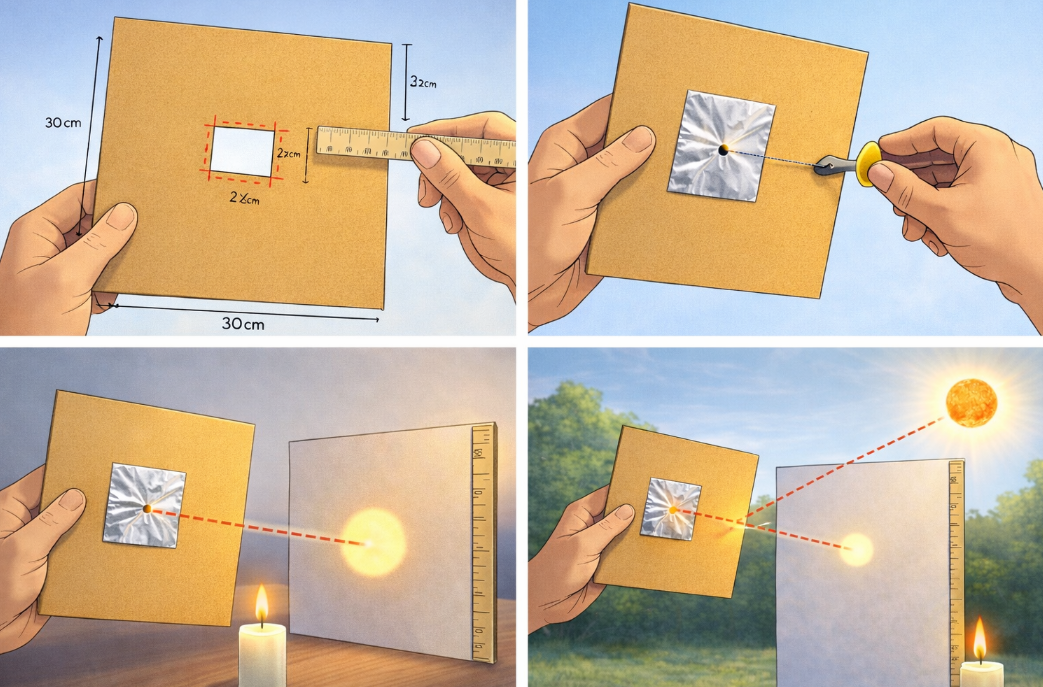
Materials
- Cardboard (30 × 30 cm / 12 × 12 in)
- Aluminum foil
- Scissors
- Ruler
- Thumbtack
- Candle
How to build it
- Cut a 2 × 2 cm (about ¾ × ¾ in) square in the center of the cardboard.
- Cover the opening with aluminum foil and make a small hole using the thumbtack.
Observe the image formed.
- First, using the candle.
- Then, by pointing the cardboard toward the Sun.
Measure
- The distance between the hole and the projected image.
- The diameter of the image formed.
Warning!
Never look directly at the Sun.
💡 Teacher's tip:
Monitor the measurements closely to ensure greater accuracy in the calculations.
Step 4 — Doing the Math
Estimating the Size of the Sun
Using the measurements you collected, estimate the Sun's diameter with the following formula:

Compare the value you calculated with the Sun's official diameter, which is 1.392.700 km (864.000 miles).
💡 Teacher's tip:
If needed, work through the calculation as a whole class to help students handle large numbers.
Step 5 — Making Connections
How Big Is "Big"?
Now that you have a sense of the Sun's approximate size, take on these challenges:
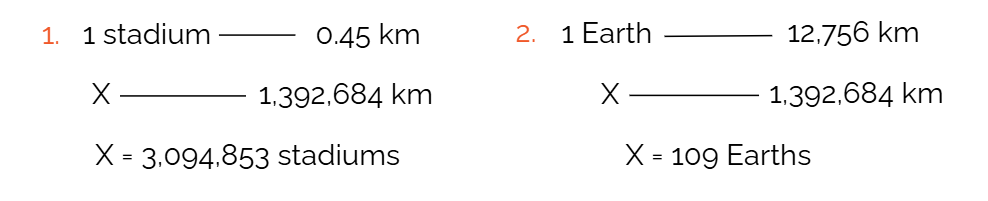
- How many soccer stadiums (0.45 km / 0.28 mi) would fit across the Sun's diameter?
- How many planet Earths would fit across the Sun's diameter?
Try to work out each answer before checking below.
Then, research the Moon's diameter and try to estimate it using the same experiment.
💡 Teacher's tip:
Use simple examples to help students work through operations involving large numbers.
Throughout this Guided Learning experience, you:
- Explored the Sun's position in the Solar System.
- Investigated astronomical distances.
- Conducted a hands-on experiment.
- Applied calculations to estimate the size of the Sun.
- Compared these dimensions to objects from everyday life.
Now that you know the numbers and understand how they were obtained, can you picture just how large the Sun really is?
👉 Want to keep learning?
Access the quizzes in the app and test your knowledge about the Solar System on Inspire Universe.
This material is protected by copyright. Reproduction, distribution, or sharing, in whole or in part, without authorization from Inspire Universe, is prohibited under Brazilian Copyright Law (Law No. 9,610/1998).

Copyright © 2025 | Universo Inspira