
What Curiosity Found on Mars After 13 Years of Combing Through Rocks
29 April 2026
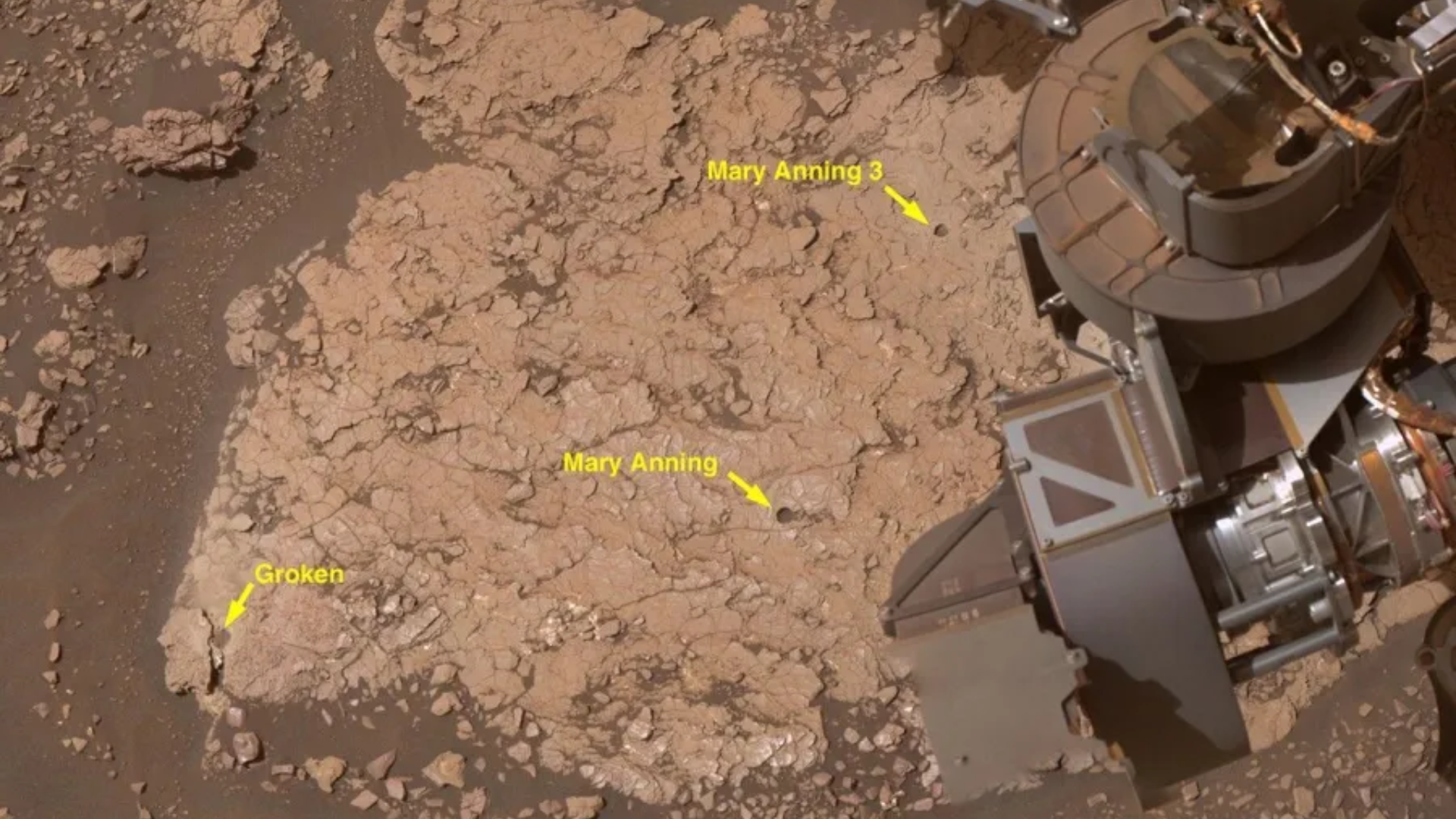
This is a close-up annotated image of three holes drilled by NASA's Curiosity rover into a Martian rock at a site nicknamed "Mary Anning," in October 2020. The sample from which the rover extracted a variety of organic molecules came from "Mary Anning 3." (A nearby spot nicknamed "Mary Anning 2" was not used.). NASA/JPL-Caltech/MSSS
The Curiosity rover identified the greatest diversity of organic molecules ever found on Mars, including seven never before detected on the planet, and one of them has a structure similar to DNA precursors.
In October 2020, the Curiosity rover drilled into a Martian rock at a site nicknamed “Mary Anning 3,” after the 19th-century British paleontologist. The sample was collected, powdered, and analyzed by a chemical laboratory built into the rover itself. But the results took years to interpret with precision, and the paper with the final conclusions was only recently published in Nature Communications.
The wait was worth it: the sample contained 21 organic molecules, the largest set ever identified in a single analysis on Mars, seven of which had never been detected on the planet before. Among them, the most significant is a nitrogen heterocycle, a carbon-nitrogen molecular structure considered a precursor to RNA and DNA.
When the Chemistry Starts to Look Familiar
Organic molecules are carbon-containing compounds found in a wide range of environments, from meteorites and interstellar gas clouds to the oceans of early Earth. While their presence on Mars was already expected, scientists were surprised by the variety and complexity of what turned up.
The nitrogen heterocycle is particularly significant because structures like it are found in the nitrogenous bases that make up DNA and RNA — the molecules responsible for storing and transmitting genetic information in every living organism on Earth. Amy Williams, a geologist at the University of Florida and lead author of the study, was direct about what the find means: “This detection is quite significant because these structures can be chemical precursors to more complex nitrogen molecules. Nitrogen heterocycles have never been found before on the Martian surface or confirmed in Martian meteorites.”
Another molecule identified was benzothiophene, a carbon-and-sulfur compound found in many meteorites, reinforcing the idea that some of Mars’s organic chemistry may have arrived on the planet carried by asteroid impacts billions of years ago.
Life or Geology? The Question That Still Has No Answer
The discovery immediately raises the most fascinating question in Mars exploration: were these molecules created by geological processes? Did they arrive via meteorites, or are they remnants of ancient life? The honest answer, for now, is that nobody knows.
Ashwin Vasavada, the mission’s chief scientist at NASA’s JPL, was careful in his comments: “This collection of organic molecules once again raises the prospect that Mars offered a home for life in the distant past.” Raises the prospect, not confirms it. Organic molecules arise naturally through chemical processes unrelated to living organisms, and Mars has a long history of volcanic activity and meteorite impacts that could account for those compounds.
The study confirms that the Martian surface can preserve complex molecules for 3.5 billion years, even under constant radiation bombardment. That preservation capacity is crucial: if life ever existed on Mars, the chemical evidence may still be there, waiting to be found.
What Comes Next?
Curiosity has now used both of its TMAH containers. But the technique that proved itself on Mars is heading to other worlds. A more advanced version of the SAM instrument, called the Mars Organic Molecular Analyzer, is being developed for the European Space Agency’s Rosalind Franklin rover. A similar instrument, the Dragonfly Mass Spectrometer, will explore Titan, Saturn’s largest moon, aboard NASA’s Dragonfly spacecraft.
In both cases, the ability to perform wet chemistry with TMAH will be carried forward, bringing to other worlds the same approach that revealed the most complex compounds ever found beyond Earth.
—
References
CNN. Curiosity rover uncovers newly detected organic molecules. Apr. 24, 2026. Available here. Accessed: Apr. 27, 2026.
NASA / JET PROPULSION LABORATORY. NASA's Curiosity finds organic molecules never seen before on Mars. Pasadena: JPL, Apr. 21, 2026. Available here. Accessed: Apr. 27, 2026.
PHYS.ORG. Mars rover detects never-before-seen organic compounds in new experiment. Apr. 21, 2026. Available here. Accessed: Apr. 27, 2026.
UNIVERSITY OF FLORIDA. Mars rover detects never-before-seen organic compounds in new experiment. Gainesville: UF News, Apr. 2026. Available here. Accessed: Apr. 27, 2026.
WILLIAMS, Amy et al. Diverse organic molecules on Mars revealed by the first SAM TMAH experiment. Nature Communications, vol. 17, art. 2748, 2026. DOI: 10.1038/s41467-026-70656-0. Available here. Accessed: Apr. 27, 2026.
See also

Copyright © 2025 | Universo Inspira